Home > Nickel Alloy > Nickel Alloy Flanges
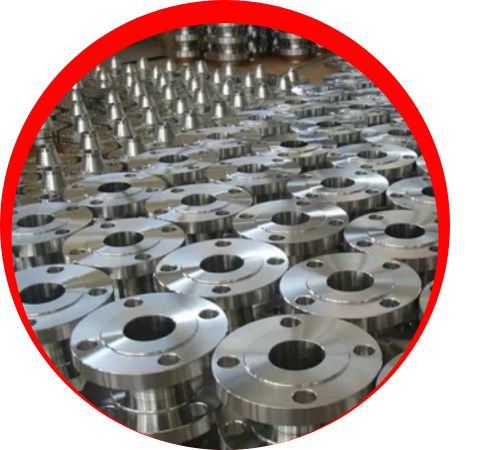
Bosega Pipes and Tubes stands out as a top-notch manufacturer and supplier of Nickel Alloy Flanges, proudly based in Cape Town, South Africa. They’ve built a solid reputation for delivering high-quality, precision-engineered products. With a keen emphasis on durability, corrosion resistance, and dimensional accuracy, this company meets a wide range of industrial needs, particularly in power generation, chemical processing, and marine sectors. Their Nickel Alloy Flanges are crafted to perform reliably even in the toughest environments and high-pressure systems, ensuring secure, leak-proof connections in piping assemblies. Bosega Pipes and Tubes is committed to maintaining its excellence through innovation, quality assurance, and a focus on customer satisfaction.
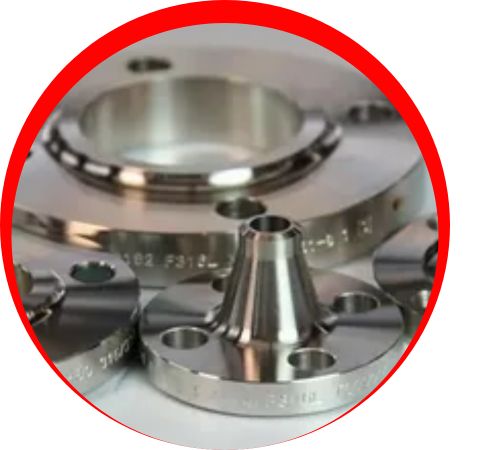
Nickel Alloy Flanges are mainly made from nickel, with added elements like chromium, molybdenum, iron, and trace amounts of carbon and silicon. This unique blend gives them remarkable resistance to oxidation, corrosion, and high-temperature scaling. On the mechanical side, these flanges boast high tensile strength, impressive ductility, and excellent creep resistance. They hold their ground under extreme heat and pressure, making them perfect for demanding applications. Their outstanding weldability and toughness guarantee longevity and reliability in critical service environments.
| Dimensions | ASTM B564 / B182 |
| Grades | Nickel Alloy |
| Size | 1/8″ NB TO 48″ NB. |
| Class | 150#, 300#, 400#, 600#, 900#, 1500#, 2500#, 3000#. Also as per the National & International Standard. |
| Standard | SORF, SOFF, SOLJ, SWFF, WNRF, WNFF, WNRTJ, LWNRF, BLRF, BLFF, BLRTJ, SWRF, LAP Joint, Threaded, Reducing, Spectacle, Orifice & Studding Outlet are manufactured according to ANSI B 16.5, B 16.47 Series A (MSS SP-44), B 16.47 Series B (API 605), MSS SP-43, DIN 2527, DIN 2566, DIN 2576, DIN 2632, DIN 2633, DIN 2634, DIN 2635, DIN 2642, BS 10, IS 1538 & IS 6392, etc |
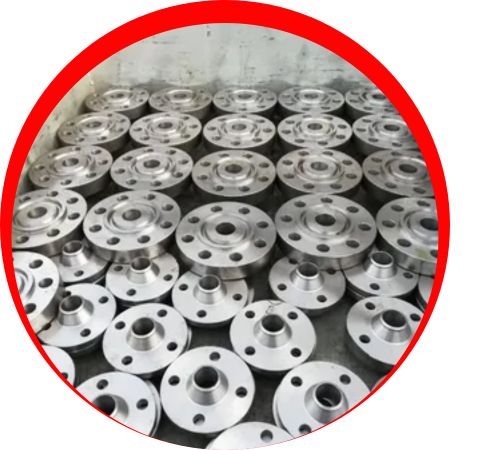
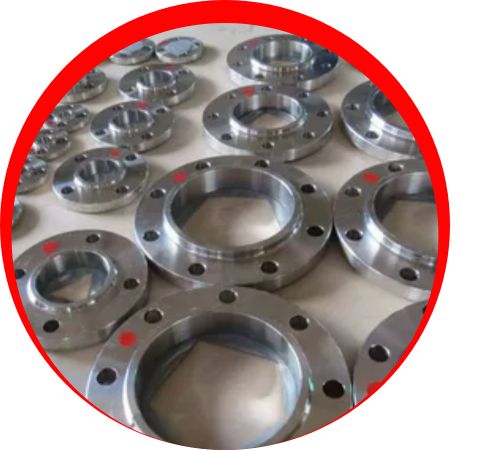
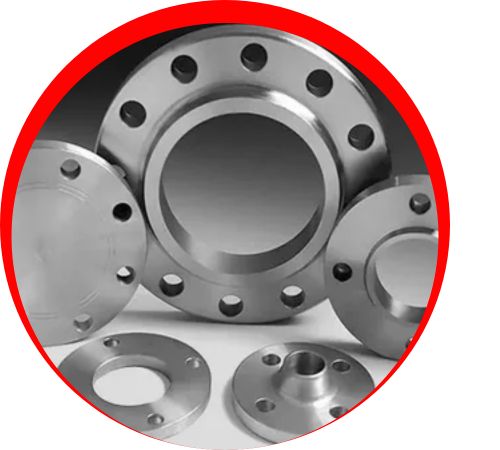
| Types of Flanges | Weld neck Flanges (WNRF), Slip-on Flanges (SORF), Blind Flanges (BLRF), Lap Joint Flanges, (SOLJ), Socket-weld Flanges (SWRF), Screwed (Threaded) Flanges, Long weld neck Flanges (LWNRF), Spectacle Blind Flanges, Spacer & Blind Flanges, Ring Type Joint Flanges (RTJ), Reducing Flanges, Raised Face (RF) Flanges, Orifice Flanges, Deck Flange, Large Diameter Flanges, Custom Flanges, Drawing Flanges, Forged Flanges, Plate Flanges, Flat Face Flanges, etc. |
| Form | Slip-On Flange (SO), Blind Flange (BL), Lap Joint Flange (LF), Socketweld Flange (SW), Weld Neck Flange (WN), Long Weld Neck Flange (LWN), Ring Type Joint (RTJ), Threaded Flange, Customized Flange with Raised Face (RF), Flat Face (FF). |
| C | Mn | Si | S | Cu | Fe | Ni | |
| Nickel | 0.15 max | 0.35 max | 0.35 max | 0.01 max | 0.25 max | 0.40 max | 99.0 min |
| Element | Density | Melting Point | Tensile Strength | Yield Strength (0.2%Offset) | Elongation |
| Nickel Alloys | 8.9 g/cm3 | 1446 °C (2635 °F) | Psi – 67000 , MPa – 462 | Psi – 21500 , MPa – 148 | 45 % |
These Nickel Alloy Flanges find their place in industries that demand exceptional corrosion and heat resistance. You’ll often see them in chemical and petrochemical plants, offshore oil and gas systems, and power generation units. They’re also vital in heat exchangers, pressure vessels, and marine equipment, thanks to their ability to withstand seawater and harsh chemicals. In the aerospace and pharmaceutical fields, Nickel Alloy Flanges play a crucial role in ensuring leak-free connections in high-temperature and high-stress systems, making them essential for applications that prioritize safety, durability, and long-lasting performance.
Contact us to get a quick quote for your requirement.
Nickel Alloy Flanges are widely used in high-stress and corrosive environments, such as in aerospace, chemical processing, and petrochemical industries. They are ideal for applications requiring exceptional resistance to extreme temperatures and harsh chemicals, including oil and gas pipelines, marine equipment, and power generation systems. Their robustness makes them suitable for high-pressure vessels, heat exchangers, and reactors. These flanges ensure secure, reliable connections in critical infrastructure, enhancing safety and performance across a range of demanding industrial applications.